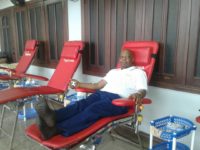
Faith in Action: How CCC is Helping Plug Ghana’s Critical Blood Deficit.
Crucial Lifeline:
In Ghana, the struggle to maintain adequate blood banks is a persistent healthcare hurdle.
The World Health Organization (WHO) recommends a benchmark of 10 units of blood per 1,000 people to safely meet national demands.
Currently, Ghana falls short of this target; while the country’s Blood Collection Index recently improved from 6.1 to 6.6 units per 1,000 people, a significant deficit remains.
Because blood cannot be manufactured or synthetically replicated, healthcare facilities rely entirely on the altruism of voluntary donors.
Without a steady supply, vulnerable patients, such as accident victims, mothers suffering from postpartum hemorrhaging, children battling severe infections, and cancer patients face life-threatening delays.
To combat this, the National Blood Service (NBS) routinely partners with corporate, educational, and religious institutions.
Among these partners, the Calvary Charismatic Centre (CCC) in Kumasi has emerged as a major institutional lifeline for the Ashanti Region.
CCC’s Impact in Kumasi:
Marking both a personal milestone and a decade-long humanitarian legacy, the General Overseer of CCC, Reverend Ransford Obeng, celebrated his 70th birthday by hosting the church’s annual voluntary blood donation drive.
Over the past ten years, this initiative has channeled thousands of life-saving units into the Komfo Anokye Teaching Hospital (KATH) Blood Bank, which serves as the Ashanti Regional Blood Centre.
Dr. Shirley Phyllis Owusu-Ofori, CEO of the National Blood Service, attended the event to praise Reverend Obeng’s sustained commitment.
“Pastor Ransford has, over the last ten years, partnered with the Komfo Anokye Teaching Hospital Blood Bank… It has been a journey of success because lives have been saved through every unit of blood collected,” Dr. Owusu-Ofori stated.
The campaign has a history of high engagement; past drives at CCC have yielded over 380 units of blood in a single day.
Despite rainy weather during this year’s drive, officials remained highly optimistic about meeting or exceeding past records.

General Overseer of CCC, Reverend Ransford Obeng with Dr. Shirley Phyllis Owusu-Ofori, CEO of National Blood Service during Saturday’s blood donation exercise that was also used to mark the 70th birthday of the CCC vision carrier.
Rippling Effect:
Dr. Owusu-Ofori emphasized that the true impact of the church’s drive extends far beyond what the congregation can visibly see. A single unit of donated blood does not just help one person—it can be separated into three distinct components:
Red blood cells (often for trauma victims and severe anemia)
Plasma (used for burn victims and volume expansion)
Platelets (critical for cancer patients undergoing treatment)
[1 Unit of Whole Blood] │├─► Red Blood Cells ──► (Saves Patient 1: e.g., Trauma/Maternal Bleeding)
├─► Plasma ──► (Saves
Patient 2: e.g., Burn/Shock Patients)
└─► Platelets ──► (Saves
Patient 3: e.g., Cancer/Leukemia Patients)
World Blood Donor Day:
The CCC donation drive served as the official launchpad for the Ashanti Regional activities commemorating World Blood Donor Day.
Celebrated globally every June, World Blood Donor Day raises awareness about the critical need for safe blood and thanks voluntary, unpaid donors for their life-saving gifts.
According to Dr. Owusu-Ofori, the global theme of humanity and selflessness perfectly mirrors the decade-long efforts of the CCC congregation.
She noted that celebrating these values publicly helps highlight how simple human compassion directly translates into medical miracles.
Debunking Myths:
A major roadblock to reaching the WHO blood donation benchmark in Ghana is the persistence of cultural myths and misinformation.
Addressing the crowd and the media, Dr. Owusu-Ofori used the platform to directly tackle these misconceptions, reassuring potential donors of both the health safety and the strict ethics of the process.
Myth: Donating blood causes permanent physical weakness or male impotence.
Fact: Blood donation is medically safe, and the body naturally replenishes lost fluids and cells within a short period without affecting long-term strength or virility.
Myth: Donated blood is used for spiritual or ritual purposes.
Fact: The NBS maintains stringent medical protocols. “There are transparent audit trails for every unit of blood collected,” Dr. Owusu-Ofori clarified. “We can trace every unit from the vein of the donor to the vein of the recipient.”
Call to Action
Closing her address, the NBS Chief Executive issued a passionate appeal to religious bodies, media houses, and ordinary citizens to actively champion the cause of voluntary blood donation.
“Blood can never be bought and it cannot be manufactured,” Dr. Owusu-Ofori reminded the public.
For Ghana to close its 3.4-unit gap and reach the safety of the WHO benchmark, it will take more communities emulating the structural commitment demonstrated by Reverend Obeng and the CCC family.
-END-